Astros Game 5 Cheating
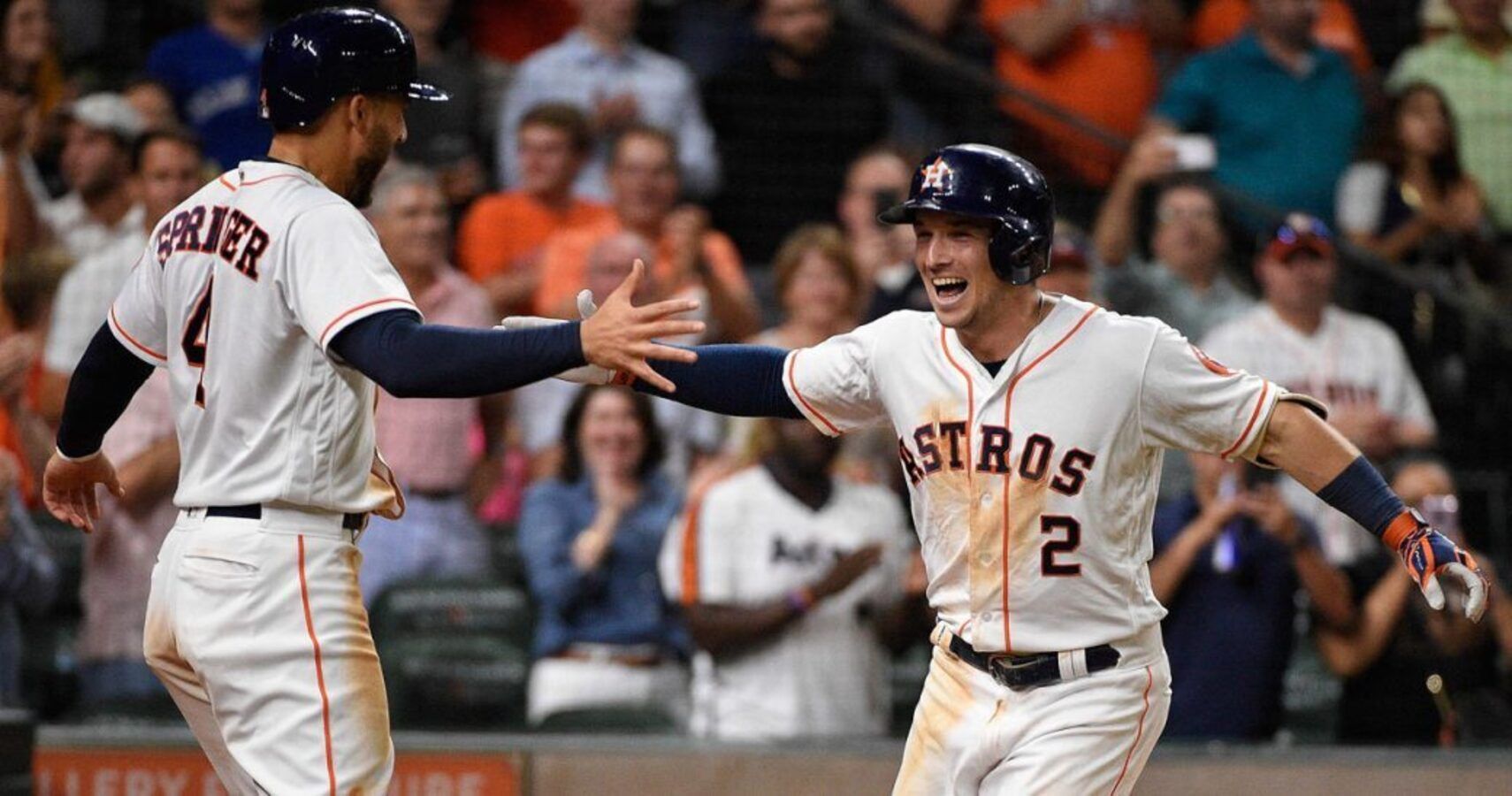
OPINION AT TEXAS SPORTS NATION: For Astros, might glory outlast shame? All 30 teams in Major League Baseball have been caught cheating to some extent. In fact, one of the game's greatest moments. The Astros are also suspected of stealing signs in the last two years as well, but The Athletic couldn’t verify those claims. 2017 game in Houston between the White Sox and Astros. Ex-pitcher: Rays think Astros using camera to steal signs in ALDS Game 5. The Astros are also known for catching tipped pitches as they famously did so in Game 7 of the 2017 World Series. One popular piece of supposed confirmation that has become widely quoted is that in Game 5 of the World Series - that wild 13-12 win for the Astros over the Dodgers - the Astros didn't have a. The Astros celebrate after Alex Bregman’ game-winning single during Game 5 of the World Series. (AP) Until that game Halloween night, the Astros will bask in the greatest win in franchise. Houston Astros manager AJ Hinch watches during Game 5 of the World Series against the Washington Nationals on Oct. 27, 2019, in Washington. (Patrick Semansky / AP) Cheating is an ever-present.
This case is not an episode of 'Law & Order,' wrapped up in a nice tidy hour of television.
The evidence is murky and inconclusive. Defender android game cheats. Then again, maybe the evidence -- such as it might be -- doesn't matter.
The Houston Astros, after all, have admitted to cheating in 2017, offering apologies for their actions if not exactly contrition for their sins. The commissioner's report on the sign-stealing scandal found the Astros, even after the September memo sent to all teams reminding them of league regulations prohibiting the use of electronic equipment for stealing signs, 'continued to both utilize the replay review room and the monitor located next to the dugout to decode signs for the remainder of the regular season and Postseason.'
The public has rendered its verdict. Case closed, World Series trophy forever tarnished.
One thing we still don't know, however: How much did the Astros actually benefit from stealing signs? One popular piece of supposed confirmation that has become widely quoted is that in Game 5 of the World Series -- that wild 13-12 win for the Astros over the Dodgers -- the Astros didn't have a single swing-and-miss against Clayton Kershaw's breaking stuff. The great Kershaw, who just five days earlier had dominated the Astros at Dodger Stadium, striking out 11 batters in seven innings. No swing-and-misses?
Is that proof? Well, for starters, it was actually one swing-and-miss against his breaking stuff, not zero, and four in the game, out of the 94 pitches Kershaw threw in Game 5. That is a low total. But even in his dominant Game 1 start at home, Kershaw induced just eight swing-and-misses, five on his breaking stuff.
With all that in mind, I thought it would be interesting to go back and watch Game 5. I also watched Game 4, when Dodgers starter Alex Wood didn't allow a hit until the sixth inning, a game the Dodgers won 6-2 (the only postseason game the Astros lost at home that year).
In comparing the two games, one thing stands out: No matter what the Astros knew or didn't know, Kershaw did not pitch a good game. His slider was inconsistent all game long, often flattening out over the middle of the plate instead of diving in and below the knees to right-handed batters. Yuli Gurriel hit a big three-run homer off a slider that tied the game 4-4 in the fourth inning and it was an absolute cookie.
None of this will change anyone's opinion on anything and there is no smoking gun, but here are my notes from re-watching the two games.
Game 4: Alex Wood
Wood had an excellent season in 2017, going 16-3 with a 2.72 ERA, including 10-0 with a 1.67 ERA in the first half. Relying on a two-seamer/changeup/curveball selection, he made the All-Star team with that huge first half, but his home run rate climbed in the second half and manager Dave Roberts moved him to the back of the rotation in the postseason. In fact, one storyline heading into his Oct. 28 start was that Wood had pitched just once in a month, starting Game 4 of the National League Championship Series 10 days earlier -- when the Cubs tagged him for three home runs in 4⅔ innings.
General observations:
You're not going to hear any trash-can banging on the Fox broadcast, or at least I couldn't while watching back on YouTube. While the commissioner's report said the Astros were still cheating in the postseason, it's possible they had changed to another identifying signal by this time. An Astros fan named Tony Adams watched 58 home games from 2017 that were available on video and listened to every pitch, logging any banging noises he heard. He tracked 8,274 pitches and found a banging noise before 1,143 of them (the bangs were deployed to indicate a breaking ball).
After the Danny Farquhar game on Sept. 21 -- when the White Sox pitcher evidently picked up on the system -- the banging slowed down. In the final two regular-season games that Adams monitored, he registered just one bang each game. In two playoff games against the Boston Red Sox, he registered just one bang. Adams does not list, however, the American League Championship Series games against the New York Yankees or the World Series games against the Dodgers.
It's important to note that you rarely see the catcher signs from the game feed. With Fox hyperactively moving from close-ups of the pitcher to the hitter to the dugout to the on-deck hitter and so on, you often don't get the center-field camera shot until the pitcher is beginning his delivery. You see the catcher signs maybe a quarter of the time. Which is why Houston bench coach Alex Cora, according to the report, arranged for a video room technician to install the monitor outside the dugout to display the live feed of the center-field camera.
OK, some notes on Wood's game in the ever-popular numbered list format:
(1) The first two pitches of the game were actually pretty constructive, showing the Dodgers were certainly suspicious that something might be going on with the Astros. I checked another feed of the game I have access to at ESPN, and on the first pitch of the game you see catcher Austin Barnes going through a series of signs, which you don't normally do with nobody on base. Before the second pitch, Wood actually stepped off the rubber and Barnes cycled through the signs again.
(2) 'We'd heard whispers of some of the shady stuff they'd been doing,' Wood told The Athletic's Andy McCullough in December. 'Obviously, we had no idea it was to the extent that came out.' The Dodgers grew even more paranoid after they witnessed the Astros using multiple signs with no runners on base during the first two games at Dodger Stadium -- the Astros themselves were paranoid about sign-stealing from the opposition. Baseball as presented by Robert Ludlum and John le Carré. As a result, Wood was constantly changing his signs. 'We probably didn't go eight or 10 pitches that whole time without changing,' he said.
(3) When Jose Altuve stepped in for his first at-bat, Fox flashed a graphic showing Altuve hitting .517 at home in seven playoff games with five home runs. 'You look at these home playoff numbers, sometimes it's hard to explain,' Joe Buck said. Well, that's one way to put it. The Astros went 8-1 at home that postseason, hitting .273/.343/.519 compared to .208/.284/.347 on the road. Of course, the Yankees went 6-0 at home and 1-6 on the road with a larger OPS difference than the Astros, so be careful where you cast your small-sample-size stones.
(4) At times, Wood and Barnes used just one sign, such as with Evan Gattis batting in the third inning. Without seeing the catcher on every pitch, it's hard to know how often the Dodgers used multiple signs and how often they used just one when nobody was on base.
(5) With Marwin Gonzalez batting in the third inning, Fox showed a graphic with the Astros' decline in strikeout rate from 2016 to 2018: From 27th to first. 'Credit the organization,' John Smoltz said. This is one of the overriding narratives about the 2017 Astros, although it's important to note that due to personnel changes (such as the addition of Gurriel and Alex Bregman's first full season), preseason forecasts projected a steep drop in strikeouts for the Astros -- with or without cheating. One study, by Rob Arthur of Baseball Prospectus, using Adams' data, concluded 'the loud banging scheme for which the Astros got caught seems to have done at least as much harm as it did good.'
At least in the regular season. But we don't really know what happened in the postseason. Like I said, it's all murky and muddy.
(6) Bregman lined out to center in the fourth on a 3-1 fastball -- with Barnes clearly flashing just one sign. Bregman hit it pretty good: 96 mph exit velocity. In fact, the Astros had a fair number of hard outs in the game, although most of those came on the ground. They had three outs against Wood on exit velocities over 100 mph; those are usually hits. They had four more outs on balls between 95 and 100 mph. Wood was good, he moved the ball around and kept everything down, but he was also fortunate in some regards. Indeed, he had just four swing-and-miss strikes out of the 84 pitches he threw. At the same time, give him credit. The Astros weren't able to lift the ball, even if they did know what was coming. Really, it shows how hard it is to hit major league pitching, even if you might know what pitch is coming.
Astros Game 5 Score
(7) George Springer finally broke up Wood's no-hitter with a two-out home run in the sixth inning, crushing a 3-1 slider into the Crawford Boxes in left field. Wood kept the pitch down, but it was over the middle part of the plate. That gave the Astros a 1-0 lead, although the Dodgers would tie the game in seventh and then score five in the ninth to even the series with a 6-2 win. I think one key aspect to Wood's game is he worked very quickly, often seemingly started his delivery as Barnes was still flashing the sign. That will be in stark contrast to Kershaw, who will slow way down when runners got on base -- in theory, making it easier for the Astros to relay stolen signs to the hitter. Of course, Wood had allowed just two walks before Springer's homer and never had to pitch with a runner on second base, making it easier to remain in a fast-paced rhythm.
Game 5: Clayton Kershaw & Co.
Let's move on to one of the wildest games in World Series, that 10-inning battle that lasted 5 hours, 17 minutes. With Kershaw pitching -- coming off that 11-strikeout outing in Game 1 -- the Dodgers built an early 4-0 lead. Kershaw couldn't hold it. The Astros tied the game but the Dodgers went back ahead 7-4. Kershaw couldn't hold that lead, either. Maybe it was the ball.
An interesting report had surfaced from Sports Illustrated's Tom Verducci prior to Game 5: The World Series baseballs were slicker than the regular-season baseballs, according to pitchers and coaches on both the Astros and Dodgers. This made it particularly hard to throw a slider, they claimed. Verducci wrote that earlier in the postseason he had heard similar complaints about the ball from the Indians.
'The World Series ball is slicker. No doubt,' Astros starter Justin Verlander said. 'I had trouble throwing the ball,' Dodgers starter Yu Darvish said. 'It was slicker.'
With that in the background, Kershaw took the ball for Game 5.
(1) Despite the concerns about the ball, the Dodgers entered Game 5 hitting .176 and the Astros entered hitting .226. Those numbers would go up after this game. It's also worth noting that Kershaw was on full rest after throwing just 83 pitches in Game 1 -- Roberts had vowed not to use him on short rest this postseason like in the past. Anyway, on Kershaw's first pitch to Springer, Barnes set up inside and the fastball was outside, off the plate. Kershaw would not have his A-plus command in this game.
(2) Kershaw ended the first by striking out Altuve swinging on a 1-2 slider -- the only swing-and-miss he'd get all game on a breaking ball. It actually wasn't a good pitch, a slider with little movement left up in the zone over the middle of the plate.
(3) Kershaw retired the first six batters, working quickly. In the second, he threw a good 2-2 slider to Gurriel that he took just below the knees -- the kind of pitch that Kershaw is used to racking up strikeouts with and might make you wonder if Gurriel knew to lay off. But he didn't throw many of those good sliders in this game.
(4) In fact, let's take a little timeout here. Kershaw would throw 39 sliders in the game with just that one swing-and-miss, plus five called strikes, seven fouls and seven balls in play. The seven balls in play resulted in three hits -- two singles and, as we'll see later, a home run by Gurriel. All three pitches were belt high, and the pitch to Gurriel was an absolute cookie.
It's not just about the swings, however. It's also about the pitches the Astros didn't swing at, like that 2-2 slider to Gurriel. Kershaw had a chase rate of 12.9% in the game on his slider and curveball. From 2016 to 2018, Kershaw had a chase rate of 34.4% on breaking balls, so the Astros were certainly disciplined in this game. In fact, over that three-year span, Kershaw had a lower chase in any game just twice -- although one of those came earlier in this postseason, in the division series against the Diamondbacks.
However, this was a problem Kershaw was having in general at this time. Remember, he had missed all of August that season with back issues. Of the 20 games over that three-year period when he induced the lowest chase rate on breaking balls, seven came between Sept. 1, when he returned from the injured list, and the end of the World Series. His chase rates on breaking balls by game that postseason: 12.5, 17.6, 20.0, 35.0, 12.9 and 28.6 (his relief outing in Game 7). Simply put, this was not vintage Kershaw. In fact, entering the game he had allowed seven home runs in his four playoff starts. Of course, it's impossible to know the effect of the Astros knowing the signs on some or all of those pitches, but this game looked like a pitcher struggling with his location and perhaps the slickness of the ball.
(5) In the bottom of third, Gonzalez took a 1-0 slider for a strike, and the camera flashed to the dugout and you saw Carlos Beltran go up to Astros manager AJ Hinch and say something to him -- one or two words. Any lip readers out there? That's the only time I saw Beltran in the dugout in the game when the camera flashed there between pitches or during celebrations (he didn't play in the game).
(6) In the bottom of the fourth, Kershaw really lost it. He walked Springer on five pitches, including two fastballs that weren't close. Altuve singled on a flat slider in the middle of the plate. With Carlos Correa up and a runner on second for the first time, Barnes went through the signs, but Kershaw stepped off the rubber and Barnes went out to the mound for a meeting.
'A change of the signs again,' Smoltz said in the booth, 'making sure [the Astros can't] decode everything they're doing.' On the 0-1 pitch, we get a good view of Barnes flashing the signs: one finger, three, two, one for a fastball inside .. and Correa doubled down the line on a fastball inside (it would have been a ball if he hadn't swung).
Verducci recently talked to Kershaw about Game 5 and Kershaw's initial comment was, 'I just pitched poorly. I lost the game.' Verducci pressed on and Kershaw said he didn't want to go there: 'I can't. It's over.'
Kershaw did eventually admit, however, that he didn't change his signs with a runner on second base. 'If you don't change your signs up every few pitches with a guy on second base, it's on you,' he said. 'I just don't want to have multiple signs with a guy on first base, you know? That slows the game down. Slows the rhythm down. And I didn't do that in Houston. I used one sign. And I should have known. They were using multiple signs all the time.'
(7) Kershaw then threw his worst pitch of the game: a first-pitch nothing slider Gurriel mashed for a game-tying three-run homer. The pitch had so little movement that Smoltz actually referred to it as a fastball.
(8) Kershaw got the first two outs in the fifth, but then Springer battled for eight pitches and walked on a 3-2 slider. Bregman battled for 10 pitches and also walked on a 3-2 slider. Did they know not to swing? That was it for Kershaw. He refused to look at Roberts when the skipper took the ball. Remember that we mentioned Wood had allowed eight balls in play of 95-plus mph? Kershaw allowed just four.
(9) Kenta Maeda came in to face Altuve. He had thrown 42 pitches in Game 3. 'You have to wonder how crisp he'll be after all the pitches he threw a couple days ago,' Smoltz said. Altuve spit at a 2-2 slider, and I've seen the Dodgers retroactively wondering he how laid off that pitch. But it wasn't really close. Smoltz even said, 'A couple of the sliders were not close enough for Altuve to swing at. [But] I almost think he has to go back to a slider on a 3-2 count.'
Maeda instead threw a changeup that Altuve pulls foul, then a fastball right down that middle that Altuve clocked 415 feet to center field to tie the game.
The interesting thing: Right before Maeda pitched, Altuve took a quick glance toward .. what, third base? It reminds me of that spat Darvish and Christian Yelich got into last year when Darvish stepped off the rubber because Yelich appears to momentarily glance toward left-center. Altuve does something similar. The conspiracy theorists might suggest a signal in the left-field scoreboard (the Astros' bullpen is in right-center). Or maybe he was just checking the positioning of the fielders or the third-base coach (although with two out and two strikes, I'm not sure he would be looking at the coach). Regardless, it was a bad pitch and Altuve didn't miss.
(10) The game only got crazier from there. Brandon Morrow, pitching for the fifth consecutive game, would come in from the Dodgers' bullpen and throw six pitches and give up four runs. Brian McCann would hit the fifth home run of the game for the Astros off an up-and-in fastball from Tony Cingrani. The Dodgers would tie it with three runs in the ninth.
Kenley Jansen came on for Los Angeles in the bottom of the ninth. With an 0-2 count on Altuve, Barnes went out to the mound. 'Again with nobody on, here in the postseason, multiple signs,' Buck said. Which is especially interesting in this case because Jansen basically throws one pitch. Off the 33 pitches he threw that night, 31 were cutters.
The Astros would beat him in the 10th. Jansen hit McCann with two out and then walked Springer. Bregman then lined a first-pitch cutter into left-center for the winning hit. Bregman had homered off Jansen in Game 4.
'I got him on a slider last night,' Bregman said after the game, 'so I knew he wasn't going to throw that. Looking for a cutter. Correa, all our hitting coaches, they all said you better stay on top of the cutter.'
Correa was asked how the Astros got it done on offense. 'Talked before the game,' he said. 'Have a good approach.'
NEW YORK -- When allegations that the Houston Astros had stolen signs electronically during their 2017 World Series championship season surfaced in November, Jimmy O'Brien was sitting in his new apartment in Harlem, waiting for some Verizon workers to finish setting up his cable internet.
Known better as Jomboy, O'Brien had broken into baseball internet prominence over the course of the 2019 season with a series of hot-mic videos that included turning New York Yankees manager Aaron Boone's 'savages in the box' rant into a viral sensation.
When O'Brien read in The Athletic's report that a banging sound could be heard from the Astros' dugout whenever a changeup signal was given by an opposing team's catcher, he quickly began scouring the MLB.TV archives, using his cellphone as a hot spot. He was far from the only one to track down Chicago White Sox reliever Danny Farquhar's now-infamous 2017 appearance in Houston, but within two hours, O'Brien had pulled the video demonstrating the banging, added his voice-over commentary, and tweeted it out.
With his phone buzzing from an influx of Twitter notifications, O'Brien called his girlfriend.
'I think I opened a can of worms,' he said.
THE CAN OF worms exploded Monday, when Major League Baseball announced one-year suspensions for Astros general manager Jeff Luhnow and manager AJ Hinch, in addition to fining the team $5 million and stripping Houston of first- and second-round draft picks in 2020 and 2021. Within hours of commissioner Rob Manfred's report, Astros owner Jim Crane fired both Luhnow and Hinch. A day later, the Boston Red Sox parted ways with their manager, Alex Cora, who had been Houston's bench coach in 2017. And on Thursday, former Astros player Carlos Beltran became the third manager to lose his job, in his case before he got the chance to skipper a single game for the New York Mets.
During MLB's three-month investigation, the public scrutiny was unprecedented, a baseball scandal -- itself about technology -- unfolding in real time, with more incriminating evidence seemingly uncovered on Twitter by the hour. Not just fans and journalists but players -- and league officials -- noticed.
The internet's social media sleuthing skills played a crucial role in shaping the investigation, dramatically reducing the time the league needed to comb through video for evidence, league sources tell ESPN. While the activity online shot a jolt of adrenaline into the baseball fan community, it was also helping to shape MLB's first uniquely 21st-century scandal.
On Nov. 13, the day after the initial report, O'Brien explained on his baseball podcast how easy it was for him to find the cuts in his viral compilation, which has garnered more than 4 million views. It helped start an avalanche. Video clips poured into his inbox from followers, and he began editing and tweeting more instances of banging, up and down the Astros' lineup. As of Thursday, his thread has more than 33,000 retweets and 100,000 likes and stands as a record of what was then a rapidly accumulating list of evidence -- tangible, easy-to-digest evidence -- against the Astros.
'I just took all the information I had from all over the place, made the video and told the story to my audience,' O'Brien says. 'But I didn't break this news. I helped accelerate it, and helped people really see. It just kept going.
'People think I'm watching hours of Astros, but nah, I crowdsource this s---.'
A Twitter timeline of O'Brien's posts that day reveals these key moments:
1:39 a.m.: O'Brien follows his initial video with a second clip of a 2017 Evan Gattis at-bat with no bang on a first-pitch fastball, two bangs on an off-speed second pitch and no bang on a third-pitch fastball.
2:02 a.m. and 2:28 a.m.: O'Brien posts similar clips featuring Josh Reddick, Jose Altuve and Carlos Correa.
12:20 p.m.: The next clip from O'Brien, a homer from George Springer, adds a new flair: a big BANG graphic, indicating when the sound is audible.
3:19 p.m.: A second follow-up clip, of an Alex Bregman home run, employs the same BANG graphic.
Astros Cheating Game 5 World Series
Over the course of the next 24 hours, more videos popped onto Twitter. Writer Ian Hunter -- @BlueJayHunter on Twitter -- put together a banging noises compilation from different Astros at-bats in Houston with then-Toronto Blue Jays pitcher Marcus Stroman on the mound, a clip Stroman himself quote-tweeted with the caption, 'This is crazy.' The clip was retweeted thousands of times, and its veracity was later confirmed by MLB's investigation, which noted in Monday's report, 'Generally, one or two bangs corresponded to certain off-speed pitches, while no bang corresponded to a fastball.'
The virality of user-generated baseball content has jumped in recent years due to the popularity of accounts such as Jomboy's and Rob Friedman's PitchingNinja -- but this was a whole new ballgame.
'Guys like Jomboy and PitchingNinja, their entire existence is digging into video like this, not necessarily to find stuff, but for entertainment purposes,' says Los Angeles-based social media consultant Lana Berry, who runs a Twitter account popular with baseball fans. 'For them, it's really easy to pull and show this video and showing where the banging is happening, and it's almost like an Easter egg hunt because it's something you can find. You can hear it. It's something tangible, whereas some of the other things coming out might be really hard to find. People are so interested because they can find information on their own. It doesn't have to be fed to them through reporters.'
The reporting that began with The Athletic's story, and later the findings on social media, led to an influx of players from opposing teams tweeting their anger about the situation, with years of rumors and gossip finally bubbling to the surface.
With more and more players sharing their thoughts online about the allegations made by former Astros pitcher Mike Fiers, fans were emboldened to keep digging and other players shared what they knew, too.
'I think that it really took someone who was on the Astros to say something,' Berry says. 'Some [players] had tweeted about it, but they seemed paranoid and salty and crazy if you're just tweeting about the bullpen coach having an earpiece and signaling to these guys. It's really easy to dismiss that and whatever, but when you have all these people from the teams who say these things are happening, it feels a lot safer to share those things that you know, because it's more of a pile-on rather than [one lone voice] being like, 'Hey, this is happening.'
HARRISON MILLER, 17, attends Colts Neck High School in Monmouth County, New Jersey, and runs @YankeeReport_, where he aggregates news, rumors and daily lineups for the Bronx Bombers.
On Nov. 17, Miller received a screenshot from an Instagram follower, taken from a 2017 World Series documentary. It showed a setup near the Astros' dugout that featured a monitor on a table with two chairs -- and a trash can that matched the description from the original report.
After posting it on Instagram and Twitter, Miller noticed Jomboy had retweeted his image.
'Really, somebody just messaged me the image and I didn't really think anything of it at the time,' Miller says. 'I decided to just throw it on Twitter and then all of a sudden, Jomboy retweeted it and I hadn't expected anything of it, and I kind of assumed it was something people already had seen. People started retweeting it, and it got really big.'
Sure enough, in its report Monday, MLB confirmed the setup. 'Cora arranged for a video room technician,' Manfred wrote, 'to install a monitor displaying the center field camera feed immediately outside of the Astros' dugout.'
Says Miller: 'There's so many things hiding pretty much in plain sight, that the average person watching the game wouldn't even consider, necessarily.'
The image kept the conversation going on Twitter. Eireann Dolan, an active member of baseball Twitter and Washington Nationals reliever Sean Doolittle's wife, corrected another user, who speculated that the monitor was for instant replay. 'It is absolutely positively not a replay monitor,' Dolan tweeted. 'Replay Monitors are in the video room in the clubhouses. There are video rooms in every clubhouse. The MLB replay monitors are in NY, but the team video staff watches game feeds in those video rooms. They call the dugout if they think something merits a challenge. There is no independent tunnel MLB replay monitor.'
The debate ensued, drawing in players, and Doolittle himself chimed in, tweeting: 'Idk I've never played on a team that's had video set up in the tunnel like that - guys had to go back upstairs. But if that's what it's for, why the towels? Why break it down after a game? Obviously don't know the whole story but I think it's more than fair to be skeptical here.'
IT'S ALSO FAIR to be skeptical of what you read on Twitter -- not every fan-fueled theory necessarily leads to the truth.
According to a report in the New York Post, scouts and executives had whispered about the Astros wearing electronic bandages to receive buzzes in real time, indicating what pitch was coming. Within a few hours, Jomboy tweeted a photo of a Band-Aid falling off the finger of an Astros player, Robinson Chirinos, following it up with, 'this could literally be anything, but I've been told the buzzers are very real.'
While many theories -- on the Astros' methods or the culpability of other teams -- remain the source of speculation as MLB continues to investigate sign stealing, the buzzing-bandages rumors got the commissioner's office on the record. Manfred told Sports Illustrated they were untrue, with the bandage in question simply a pad to protect a bone bruise.
'I will tell you this: We found no Band-Aid buzzer issues,' Manfred said. 'There's a lot of paranoia out there.'
Manfred's assertion hasn't put the buzzer issue to rest. Social media is still questioning the degree of rule-breaking by the Astros, even with an official report released. As late as this Thursday, the discussion continued in the wake of Beltran's parting from the Mets, leading to a wild day on Twitter, plus a denial from Altuve and a statement from MLB that it 'explored wearing devices during the investigation but found no evidence to substantiate it.'
When debate over the Astros' approach went beyond trash-can banging over the past few months, other theories were advanced. To counter one, Astros fan Tony Adams posted a video purporting to log every 'charge' whistle from Game 5 of the 2017 World Series and show there was no correlation between the whistling and sign stealing.
'You're going to get A LOT of mad yankee fans in here. Prepared [sic] for a bad like/dislike ratio lol,' responded one YouTube commenter, ostensibly referring, at least in part, to chatter during the 2019 ALCS that Houston used whistling to transmit illegally stolen signs against New York.
Astros Cheating Scandal
But when Manfred released his report Monday, it underscored how the line between fact and fan fiction -- if it is indeed fiction -- can blur when a major story breaks online. 'Witnesses explained that they initially experimented with communicating sign information by clapping, whistling, or yelling,' he wrote, 'but that they eventually determined that banging a trash can was the preferred method of communication.'
He also noted 'the investigation revealed no violations of the [revised sign-stealing] policy by the Astros in the 2019 season or 2019 Postseason.' /home-makeover-4-game-cheats.html.
As the release of MLB's report loomed, the conversation online progressed, for better and worse, and social media continued to have a profound effect. If nothing else, memes helped keep the pressure on MLB officials and the Astros, even as the platform served as a welcome reminder that you can't believe everything you read on the internet.
Baseball Cheating Scandal Astros
THE ASTROS' SIGN-STEALING saga has captured the attention of hardcore and casual fans alike, the biggest baseball scandal since steroids infiltrated the daily discourse of the sport at the turn of the century.

Astros Dodgers Game 5 Cheating
But as this controversy made its way from front offices to subreddits, it sparked fans to become further invested in the sport, as they analyzed video clips and devoured Twitter threads, all while major league players publicly discussed the integrity and the future of the game with them.
'It's so interesting from my perspective because it used to feel like old-school message boards and stuff that interested us as a baseball fan to now, everyone knows the writers or are friends with the writers or are friends with the players because so many more of them are active on Twitter,' Berry says. 'Now that we have players tweeting, and players probably helping other guys who are giving information, it all feels more centralized where you feel like you can influence the game because you are actually involved versus when it was just fans getting into the game.'
Baseball's latest scandal is the result of a slow response to quickly evolving technology amid the sport's implementation of instant replay review, but it has put the collective power of the internet on display in a manner that would not have been possible just 10 years ago.
'People are bored at work. You're just watching videos and hearing for bangs. They're actually talking about it on the news cycle,' O'Brien says. 'It's a whole new world.'